Hernia Symptoms & Early Care
When to See a Hernia Surgeon
A hernia does not always announce itself with dramatic pain. It often starts as a small bulge you notice while lifting something heavy, or a dull ache that shows up by the end of the day and disappears overnight. Because early symptoms can be mild and easy to dismiss, many people put off seeing a doctor until the hernia has grown larger or started causing real discomfort.
This guide covers the early signs that suggest it is time to book a consultation, the type-specific symptoms worth knowing, and the warning signs that mean you should seek care immediately rather than waiting for a scheduled appointment.
What Is a Hernia, in Simple Terms?
A hernia occurs when an internal part of the body, usually a portion of fatty tissue or intestine, pushes through a weak spot in the surrounding muscle or connective tissue. Most hernias develop in the abdominal wall, though the exact location and appearance depend on the type.
Hernias do not heal or close on their own. Once the weak spot is there, it typically stays the same size or gradually enlarges over time, which is why the warning signs below are worth paying attention to rather than waiting out.
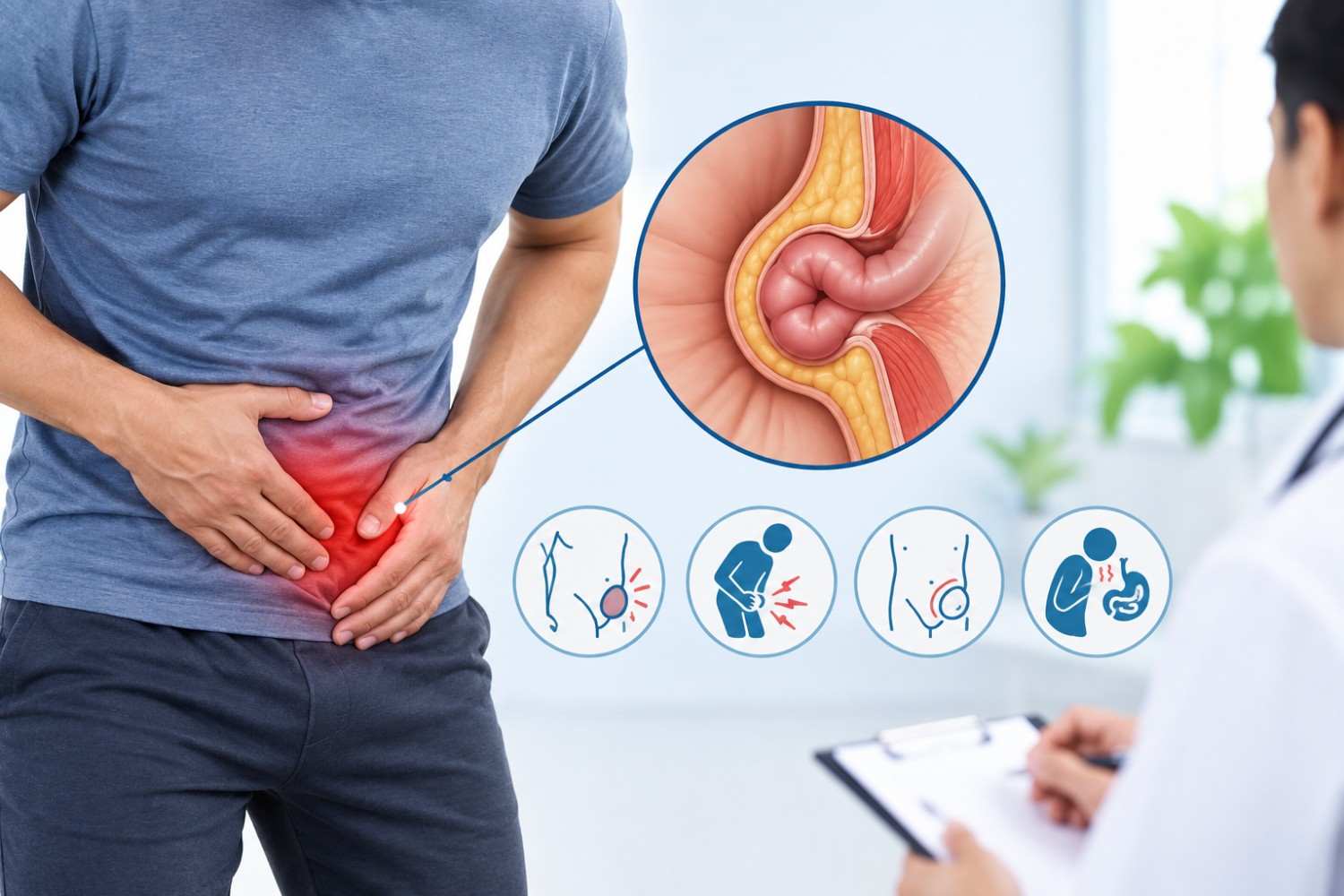
Early Clinical Indicators
Early Signs a Hernia May Be Forming
These are the symptoms that usually appear first, often mild enough that people wait weeks or months before mentioning them to a doctor. A hernia identified early is generally easier to treat than one left to enlarge.
Visible Bulge or Swelling
A soft bulge or swelling that becomes more noticeable when standing, straining, coughing, or lifting, and that flattens or disappears completely when lying down.
Dull Ache or Heaviness
A persistent dull ache, heaviness, or pulling sensation in the abdomen or groin area, especially following physical exertion, long walks, or heavy lifting.
Diurnal Discomfort
Discomfort that builds gradually throughout the day as abdominal pressure accumulates, which noticeably eases after a period of rest or overnight sleep.
Localized Weakness or Pressure
A distinctive feeling of muscle wall weakness or internal pressure in the affected abdominal or groin zone, even before a distinct bulge becomes visible.
Acid Reflux & Heartburn
In hiatal hernias, symptoms present internally as frequent acid reflux, severe heartburn, or burning chest discomfort rather than an external visible bulge.
Progressive Enlargement
A small bulge that steadily increases in size over months, indicating that the muscular defect is widening and requires specialist surgical review.
Specialist Profile
Consult Dr. Ashish Vashistha in Delhi
Dr. Ashish Vashistha is a laparoscopic and robotic surgeon with 28+ years of experience, currently serving as Principal Director and Head of the Department of General Surgery & Robotics at Max Super Speciality Hospital, Saket, New Delhi.
His hernia practice has been recognized as a Centre of Excellence for Hernia Surgeries by the Hernia Society of India, reflecting a sustained focus on hernia care across inguinal, umbilical, femoral, incisional, hiatal, and ventral hernias.
If you have noticed a bulge, persistent discomfort, or any of the warning signs described in this guide, an evaluation can clarify what you are dealing with and what your options are, before the situation becomes more urgent.
Experience:
28+ years across advanced laparoscopic, robotic, and general hernia surgery.
Recognition:
Centre of Excellence for Hernia Surgeries, awarded by the Hernia Society of India.
Hospital Infrastructure:
Max Super Speciality Hospital, Saket, South Delhi, serving patients across Delhi and NCR.
Surgical Precision:
Both laparoscopic and robotic hernia repair options matched to the patient's specific hernia complexity.
What Happens During a Hernia Consultation
A structured clinical assessment ensures that the exact location, size, and severity of the muscle defect are identified before deciding on the treatment strategy.
Physical Exam
Evaluation of the bulge by feel and how it responds to standing, coughing, straining, or gentle reduction.
Diagnostic Imaging
High-resolution ultrasound or CT scan if required to clarify hernia margins, depth, or trapped tissue contents.
Clinical History
Detailed review of symptom onset, aggravating triggers, previous surgeries, and overall physical activity.
Tailored Roadmap
Discussion on whether monitoring, lifestyle guidance, or laparoscopic/robotic repair is the right next step.
Strategic Care
Why “Watching and Waiting” Is Not Always the Safer Option
Some small, symptom-free hernias, particularly certain umbilical or inguinal hernias in adults, may be reasonably monitored for a period under a surgeon's guidance rather than operated on immediately. This is a decision made with a doctor, not a default assumption.
The risk with waiting on your own, without medical input, is that hernias tend to enlarge gradually, and a larger hernia is generally more complex to repair than a smaller one, with a longer recovery. Waiting also carries the background risk of incarceration or strangulation. A consultation early on gives you an informed choice rather than a default of inaction.
Modern Surgery
Treatment Options Once Surgery Is Recommended
When surgery is the right step, both laparoscopic and robotic mesh repair are minimally invasive options that generally allow for less post-operative pain and a faster return to normal activity compared with open surgery.
Laparoscopic repair remains a well-proven option for most inguinal and umbilical hernias, while robotic repair can offer added precision for complex, recurrent, or bilateral cases. The right technique depends on the hernia's size, location, and your overall health, which is why this decision is made individually with your surgeon rather than applied as a default.
Warning Signs by Hernia Type
Different hernias tend to show up in different locations, and recognizing the pattern can help you describe your symptoms more precisely during a consultation.
| Hernia Type | Where It Appears | Early Warning Sign to Watch For |
|---|---|---|
| Inguinal | Groin, more common in men | A bulge in the groin that appears or grows with standing, lifting, or coughing |
| Umbilical | Around the navel | A soft swelling at or near the belly button, more noticeable when straining or crying (in infants) |
| Femoral | Upper thigh, more common in women | A bulge or pressure in the upper thigh or groin crease, sometimes mistaken for a lymph node |
| Incisional | At the site of a previous surgical cut | A bulge that develops along or near an old surgical scar, weeks to years after surgery |
| Hiatal | Upper stomach, through the diaphragm | Heartburn, acid reflux, or a burning sensation in the chest that worsens after meals or when lying down |
| Ventral | Anywhere along the abdominal wall | A bulge along the midline or sides of the abdomen, often more visible when tensing the muscles |
Surgical Emergency
When It Becomes Urgent: Strangulated or Incarcerated Hernia
Most hernias are not medical emergencies, but a hernia can become dangerous if the tissue pushing through the weak spot gets trapped (incarcerated) and loses its blood supply (strangulated). Seek urgent medical care immediately if you notice:
- A bulge that suddenly becomes firm, tender, or cannot be gently pushed back in
- Severe, worsening pain at the hernia site rather than the usual dull ache
- Redness, discoloration, or localized heat over the bulge
- Nausea, vomiting, or an inability to pass gas or stool (bowel obstruction)
- Fever accompanying any sudden swelling or localized abdominal pain
Emergency Notice: These signs suggest trapped tissue is deprived of blood flow. Delaying emergency treatment can allow tissue damage and gangrene to progress. In this situation, waiting for a scheduled consultation is not appropriate.
Clinical Timelines
Routine Consultation vs. Immediate Emergency Care
Understanding whether your symptoms warrant an outpatient appointment or immediate emergency hospital admission can save tissue and prevent serious complications.
- Schedule a Consultation: If the bulge is soft, reduces easily when lying down, causes mild discomfort after exercise, or slowly appeared over several months.
- Go to the Emergency Room: If a reducible hernia suddenly locks in place, turns dark red/purple, triggers uncontrollable pain, or causes persistent vomiting.
- Femoral Hernia Caution: Because femoral hernias have a narrow orifice, they carry a higher statistical risk of sudden strangulation and are rarely left to 'wait and watch'.
At Max Super Speciality Hospital, Saket, Dr. Ashish Vashistha provides complete elective and urgent evaluations to address hernia defects safely.
Treatment Journey
From Early Diagnosis to Full Recovery
Addressing a hernia early provides access to minimally invasive surgical repairs that minimize hospital stay and support swift recovery.
Phase 1: Timely Assessment
Clinical examination establishes the hernia type and size, ensuring you avoid emergency complications like incarceration.
Phase 2: Minimally Invasive Repair
Laparoscopic or robotic keyhole mesh repair secures the defect with tiny incisions, minimal tissue trauma, and precise placement.
Phase 3: 1-2 Weeks Recovery
Light walking is started promptly. Most minimally invasive surgery patients return to standard daily routines within one to two weeks.
Phase 4: Full Activity
By 4-6 weeks, mesh integration restores abdominal wall integrity, allowing safe resumption of strenuous exercise and lifting.
Frequently Asked Questions
No. A hernia will not close or heal on its own, since it involves a physical gap in the muscle or connective tissue. Some small, symptom-free hernias can be monitored under medical guidance, but the underlying weak spot does not resolve without repair.
Yes, this is common. Many people notice more discomfort by the end of the day, after standing or physical activity, and relief when lying down, since the pressure on the weak spot changes with posture and activity.
This depends on the type, size, and symptoms. Some hernias are monitored for a period, while others, especially those causing significant pain or at higher risk of complications, are recommended for earlier repair. This is assessed individually rather than following a fixed timeline.
Avoiding heavy lifting, managing chronic cough or constipation, and maintaining a healthy weight can reduce strain on the affected area, but these measures do not repair an existing hernia. They may help manage symptoms while you decide on next steps with your surgeon.
Both occur in the groin area, but an inguinal hernia is more common in men and sits higher in the groin, while a femoral hernia is more common in women and sits lower, near the upper thigh. Femoral hernias carry a comparatively higher risk of complications and are often recommended for earlier repair.
If you have noticed a bulge, persistent discomfort, or any of the warning signs described above, an evaluation can clarify what you are dealing with and what your options are, before the situation becomes more urgent.
Book a Consultation at Max Super Speciality Hospital, Saket