Bariatric Surgeon in Delhi: Weight Loss & Metabolic Surgery
If diet and exercise haven't been enough to manage your weight, and it's starting to affect your health rather than just your appearance, bariatric surgery might be worth a serious conversation. It's a bigger decision than most surgeries, not because the procedures themselves are unusually risky when done well, but because it changes how you eat and live for the rest of your life. That's exactly why the surgeon and the evaluation process matter as much as the operation itself.
Dr. Ashish Vashistha is Principal Director and Head of the Department of General Surgery & Robotics at Max Super Speciality Hospital, Saket, with close to three decades of surgical experience and dedicated international training specifically in bariatric surgery. This page covers what bariatric surgery actually involves, who it's suitable for, how the right procedure is chosen, and what life looks like afterward.
What is Bariatric Surgery
Bariatric surgery refers to a group of procedures that help with significant, sustained weight loss by changing how the stomach and, in some procedures, the small intestine process food. It's often called metabolic surgery too, because beyond weight loss, it can meaningfully improve or even resolve conditions like type 2 diabetes and high blood pressure in appropriate candidates.
Today, these procedures are almost always performed laparoscopically, through a small number of keyhole incisions using a camera and fine instruments, rather than through a large open cut. Some centres, including this one, also offer a robotic-assisted approach for suitable cases. Either way, this is a considered surgical decision, not a shortcut, and it works best as part of a broader plan that includes diet, activity, and long-term follow-up.
Am I a Candidate for Bariatric Surgery?
Bariatric surgery is generally considered for:
- A BMI of 40 or higher, regardless of other health conditions
- A BMI of 35 to 39.9 combined with obesity-related conditions such as type 2 diabetes, high blood pressure, or obstructive sleep apnea
- Documented difficulty achieving or maintaining weight loss through diet, exercise, and medical management alone
- Weight that is meaningfully affecting daily function, mobility, or overall quality of life
You can get a quick sense of where you stand using the BMI calculator on this page, though BMI alone doesn't decide candidacy. A full evaluation looks at your overall health, existing conditions, and weight history together.
Health Conditions Bariatric Surgery Can Help Improve
Weight loss surgery is often considered not just for weight itself, but for the health conditions that come with excess weight, including:
- Type 2 diabetes
- High blood pressure
- Obstructive sleep apnea
- Non-alcoholic fatty liver disease
- Joint pain and reduced mobility linked to excess weight
- Polycystic ovary syndrome, in some patients
Improvement in these conditions varies from person to person and depends on factors like how long you've had the condition and how your body responds after surgery. It isn't guaranteed to resolve every condition completely, but many patients see meaningful improvement, sometimes to the point of reducing or stopping certain medications, always under medical supervision.
How Is the Right Procedure Decided?
A responsible bariatric programme doesn't jump straight from consultation to surgery. The typical evaluation includes:
- A detailed medical history and physical examination
- Blood work and relevant imaging to check overall fitness for surgery
- A nutritional assessment with a dietician
- A psychological evaluation, since long-term success depends heavily on being mentally prepared for the lifestyle changes involved
- A discussion of which procedure fits your weight, health conditions, eating habits, and goals
This process typically takes a few weeks, and that's by design. It's meant to set you up for a procedure that actually fits your situation, rather than defaulting to whatever's most commonly performed.
Types of Bariatric Surgery
There isn't one bariatric procedure that suits everyone. The right choice depends on your BMI, existing health conditions, eating patterns, and what you and your surgeon decide together after evaluation.
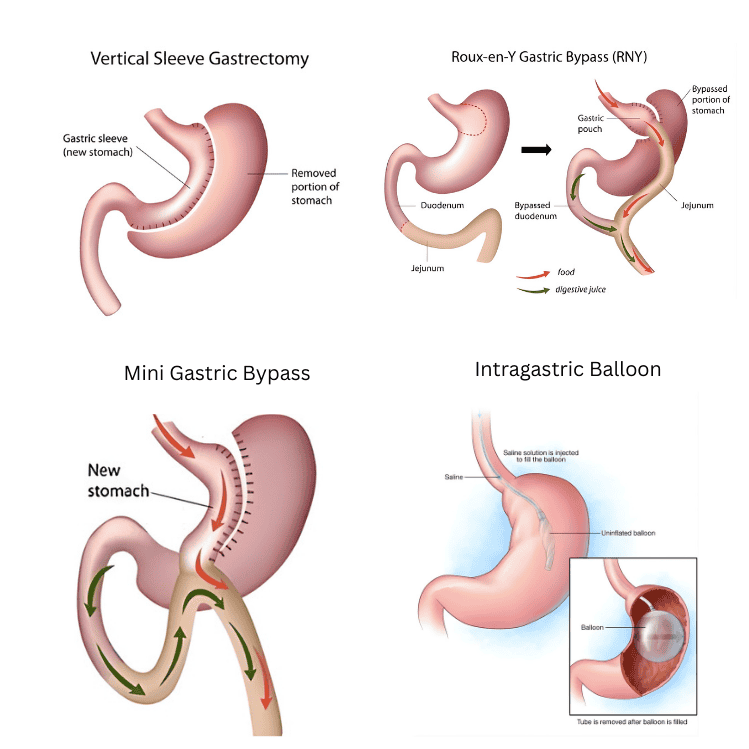
This is currently the most commonly performed bariatric procedure. The surgeon removes a large portion of the stomach, leaving behind a narrow, banana-shaped sleeve. This reduces how much food you can eat at one time and also lowers the levels of a hormone that drives hunger. It's a purely restrictive procedure, meaning it doesn't reroute the intestines, which makes it somewhat simpler than a bypass while still delivering substantial weight loss for most patients.
Gastric bypass involves creating a small stomach pouch and connecting it directly to a lower section of the small intestine, bypassing part of the digestive tract. It combines restriction with a degree of reduced nutrient absorption, and tends to be considered for patients with more significant obesity or poorly controlled type 2 diabetes, since it often has a strong effect on blood sugar control independent of weight loss
Adjustable Gastric Banding
This involves placing an adjustable band around the upper part of the stomach to limit food intake. It's a reversible procedure, but it's used far less often today than sleeve gastrectomy or bypass, partly because long-term outcomes and revision rates haven't compared as favourably. It may still be discussed for select patients, but it's no longer considered a first-line option at most centres.
Revision (Redo) Bariatric Surgery
If a previous bariatric procedure hasn't delivered the expected results, or has led to complications like band slippage, inadequate weight loss, or significant weight regain, a revision procedure may be an option. This is generally more complex than a first-time surgery and requires a careful review of exactly what was done originally and why the outcome fell short, before deciding on next steps.
Laparoscopic vs Robotic Bariatric Surgery: What's the Difference?
Both approaches achieve the same surgical goal, using small incisions rather than a large open cut. The difference is in how the surgeon operates:
-
Laparoscopic surgery uses a camera and hand-held long instruments, controlled directly by the surgeon at the operating table.
-
Robotic-assisted surgery uses a surgical console where the surgeon controls robotic arms with enhanced range of motion, magnified 3D vision, and finer precision, which can be particularly useful in more complex or revision cases.
Both are considered minimally invasive and are performed regularly here. If you'd like a closer look specifically at the robotic approach, you can read more on our robotic bariatric surgery page. Which one is right for you is a conversation to have during your consultation, based on your specific case rather than a general preference for one technology over another.

How to Choose a Bariatric Surgeon in Delhi
Bariatric surgery isn't a one-time transaction. It's the start of a long-term relationship with a surgical team that should be with you through the procedure and years of follow-up afterward. Before choosing a surgeon, it's worth checking for:
- Dedicated bariatric training, not just general laparoscopic experience
- A real multidisciplinary team, including a dietician and, ideally, psychological support, not just a surgeon working alone
- A clear explanation of why a specific procedure is being recommended for you, rather than a one-size-fits-all default
- Experience managing complications and revision cases, since this indicates depth of practice, not just volume
- A structured long-term follow-up plan, including nutritional monitoring, since bariatric surgery patients need supplementation and check-ins for years, not just weeks
Dr. Ashish Vashistha is MBBS, MS (General Surgery), and holds fellowships including FALS in Bariatric Surgery, alongside FNBE (Minimal Access Surgery), FIAGES, FALS (Hernia), and FALS (Robotics). He currently serves as Principal Director and Head of the Department of General Surgery & Robotics at Max Super Speciality Hospital, Saket, New Delhi. His bariatric training includes dedicated fellowship programmes at University Hospital Innsbruck, Austria (Roux-en-Y gastric bypass and adjustable gastric banding), further training in Vienna and Krems, Austria, and at the European Georges Pompidou Hospital in Paris under Professor Jean-Marc Chevallier, along with advanced bariatric training at Cleveland Clinic Florida, USA, under Professor Raul J. Rosenthal. He is a member of the Obesity Surgery Society of India and has been involved in national consensus discussions on obesity management in India. He also played a pioneering role in establishing one of the first comprehensive bariatric and metabolic surgery programmes in Bathinda, Punjab, extending access to this kind of specialist care beyond major metropolitan centres.
Book a Consultation with Dr. VashisthaBariatric Surgeon in South Delhi
Dr. Vashistha's practice is based at Max Super Speciality Hospital, Press Enclave Road, Saket, New Delhi, within the South Delhi district. Patients from Saket and nearby South Delhi neighbourhoods such as Malviya Nagar, Hauz Khas, Panchsheel Park, Greater Kailash, and Vasant Kunj often prefer a bariatric evaluation close to home, given that the process involves multiple visits: initial evaluation, dietician and pre-surgical assessments, the procedure itself, and a long-term follow-up schedule that continues well beyond recovery.
If you're in South Delhi and considering bariatric surgery, having your surgical team, dietician, and follow-up care in one accessible location makes a genuinely long process easier to manage.
Bariatric Surgery Cost in Delhi
Bariatric surgery cost depends on several factors that vary by patient, including:
- The specific procedure recommended (sleeve, bypass, banding, or a revision procedure)
- Whether the laparoscopic or robotic approach is used
- Pre-surgical evaluation and testing
- Hospital stay and operation theatre charges
- Nutritional counselling and the post-operative follow-up programme
- Any additional procedures required for complex or revision cases
Because these factors differ meaningfully between patients, an accurate cost estimate is only possible after a proper evaluation. If you'd like clarity on what your specific case might involve, the most reliable next step is a consultation.
Recovery After Bariatric Surgery
With laparoscopic or robotic techniques, hospital stays are typically short, often one to two days, though this depends on the procedure and your individual recovery. General recovery guidance includes:
- Early movement: Walking soon after surgery helps reduce the risk of blood clots and supports recovery.
- Diet progression: Following the staged liquid-to-solid diet plan closely, rather than rushing back to regular food.
- Pain management: Some discomfort around the incision sites is normal in the first few days and is generally well controlled with prescribed medication.
- Activity restrictions: Avoiding heavy lifting and strenuous activity for the period your surgeon specifies.
- Follow-up visits: These are not optional extras. They're how your team monitors healing, nutrition, and progress in the weeks and months after surgery.
Frequently Asked Questions
A gastric sleeve removes a large portion of the stomach to reduce its capacity, while a gastric bypass creates a small pouch and reroutes part of the small intestine. Bypass tends to have a stronger effect on blood sugar control and is often considered for patients with poorly controlled type 2 diabetes, while sleeve gastrectomy is generally a somewhat simpler procedure with substantial weight loss for most patients. The right choice depends on individual evaluation.
Not necessarily. While a BMI of 40 or above is one criterion, people with a BMI of 35 to 39.9 combined with conditions like type 2 diabetes or high blood pressure may also be candidates. Eligibility is based on overall health, not BMI alone.
Both are minimally invasive and effective. Robotic surgery offers enhanced precision and range of motion, which can be particularly useful for complex or revision cases, but for many standard cases, laparoscopic surgery achieves equally strong outcomes. Which approach fits your case is best discussed during consultation.
For most patients, especially after gastric bypass, some level of lifelong vitamin and mineral supplementation is recommended, since the surgery changes how your body absorbs certain nutrients. Your surgical team will guide you on exactly what's needed based on your procedure and regular blood work.
Adjustable gastric banding is technically reversible, since the band can be removed. Sleeve gastrectomy and gastric bypass are generally considered permanent, though gastric bypass can sometimes be revised in certain situations. Reversal or revision decisions are made on a case-by-case basis.
Some weight regain over the years is common and doesn't necessarily mean the surgery failed. Staying connected to your follow-up programme helps catch this early, when dietary and lifestyle adjustments are often enough. In some cases, a revision procedure may be discussed if regain is significant.
With laparoscopic or robotic techniques, hospital stays are typically short, often one to two days, though this varies based on the specific procedure and your individual recovery.
Coverage varies significantly between insurance providers and policies, and often depends on whether the surgery is classified as medically necessary based on your BMI and associated health conditions. It's worth checking directly with your insurer and discussing documentation requirements with your surgical team.
Yes. Dr. Vashistha's practice is based at Max Super Speciality Hospital in Saket, within the South Delhi district, and sees patients from Saket and surrounding South Delhi areas for bariatric evaluation and surgery.
The terms are closely related. "Metabolic surgery" emphasizes the procedure's effect on obesity-related metabolic conditions like type 2 diabetes, while "bariatric surgery" emphasizes weight loss. In practice, the same procedures (sleeve, bypass) are often described using either term, sometimes both together.
This is decided after a full evaluation that looks at your BMI, existing health conditions, eating habits, and personal goals, along with input from a dietician and, where relevant, a psychological assessment. There's no single "best" procedure that applies to everyone.
Revision bariatric surgery is an option for patients who haven't achieved expected results or who've experienced complications with a previous procedure. It typically requires a detailed review of your surgical history before deciding on next steps, since revision surgery is generally more complex than a first-time procedure.