If your surgeon has mentioned robotic surgery for your hernia, it's usually because your case isn't the most straightforward one, a recurrence, a hernia on both sides, or a location that's harder to access with standard laparoscopic instruments. As a hernia surgeon in Delhi with close to three decades of general and minimally invasive surgical experience, Dr. Ashish Vashistha uses robotic-assisted technique specifically where its added precision makes a real difference, not as a default upgrade for every patient.
Dr. Vashistha is Principal Director and Head of the Department of General Surgery & Robotics at Max Super Speciality Hospital, Saket.
What Makes Robotic Hernia Surgery Different?
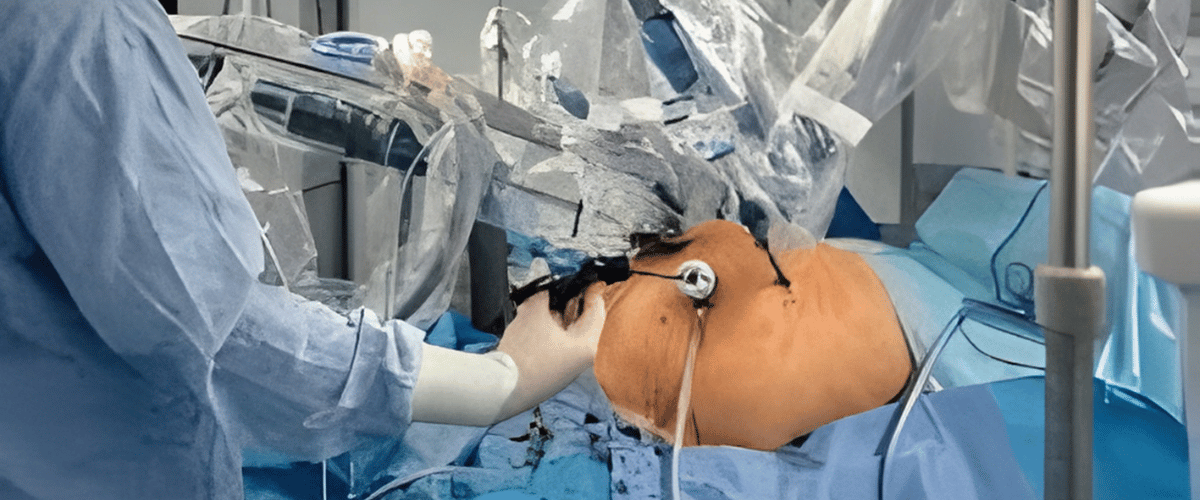
Robotic hernia repair uses the same underlying surgical principles as laparoscopic surgery, small incisions, mesh reinforcement of the weakened area, but the surgeon operates through a console that translates hand movements into finer, more articulated instrument control, with a magnified 3D view of the surgical field. This gives more precise suturing and mesh placement in tight or awkward anatomical spaces than is possible with standard laparoscopic instruments, which move with less range of motion.
Why Choose Robotic Hernia Repair
Robotic hernia surgery uses a console-controlled system that gives Dr. Vashistha a magnified 3D view and a wider range of instrument movement than standard laparoscopic tools. This added precision is particularly useful for complex, recurrent, or bilateral hernia cases, where exact mesh placement makes a real difference to long-term outcomes.
When Robotic Repair Makes the Most Sense
Robotic technique isn't automatically the better choice for every hernia. Its real advantage shows up in specific situations:
Recurrent hernias: When a hernia has come back after previous repair, the anatomy is often distorted by scar tissue, and the extra precision and visualization robotic surgery offers can matter more here than in a first-time repair.
Bilateral hernias: When hernias are present on both sides, robotic technique allows both sides to be addressed through the same set of incisions with consistent precision.
Complex or large hernias: Larger defects, or hernias close to major blood vessels or nerves, benefit from the finer control and 3D visualization robotic instruments provide.
Difficult anatomical locations: Certain hernia positions are harder to access with standard laparoscopic tools, where the robotic system's wider range of motion helps.
For a straightforward, first-time, small hernia, standard laparoscopic repair often achieves an equally strong outcome. The right approach depends on your specific case, which is exactly what a proper evaluation is for.
Common Hernia Conditions Treated
Symptoms That Suggest You Should See a Hernia Surgeon
- A visible bulge or swelling in the groin, abdomen, or near the navel, more noticeable when standing or straining
- Pain or a burning sensation while lifting, bending, or coughing
- A feeling of pressure or weakness in the affected area
- Discomfort that worsens through the day and eases when lying down
- In more advanced cases, nausea or digestive discomfort
Early consultation with a hernia specialist in Delhi generally means simpler treatment and a smoother recovery than waiting until the hernia has enlarged or caused complications.

Robotic vs Laparoscopic vs Open Hernia Surgery
All three approaches share the same surgical goal, repositioning the herniated tissue and reinforcing the weakened area with mesh. Where they differ:
Laparoscopic Surgery
- Uses small keyhole incisions with standard hand-held instruments, and is highly effective for most straightforward, first-time hernias.
Robotic Surgery
- Uses the same keyhole approach with console-controlled instruments offering greater precision and range of motion, particularly valuable for recurrent, bilateral, or complex hernias as described above.
Open Surgery
- Uses a single larger incision. It remains appropriate for certain emergency cases or when minimally invasive access isn't suitable.
Which one fits your case is a decision made after evaluating your specific hernia, not a default recommendation.
Discuss Which Approach Fits Your CaseHow to Choose a Robotic Hernia Surgeon in Delhi
A few things worth checking:
- Genuine experience with recurrent and bilateral hernia repair, not just general robotic surgery volume
- A clear explanation of why robotic technique is being recommended for your specific case, rather than by default
- Comfort with open and laparoscopic techniques too, since not every hernia needs a robotic approach
- A structured follow-up plan to catch any early signs of recurrence
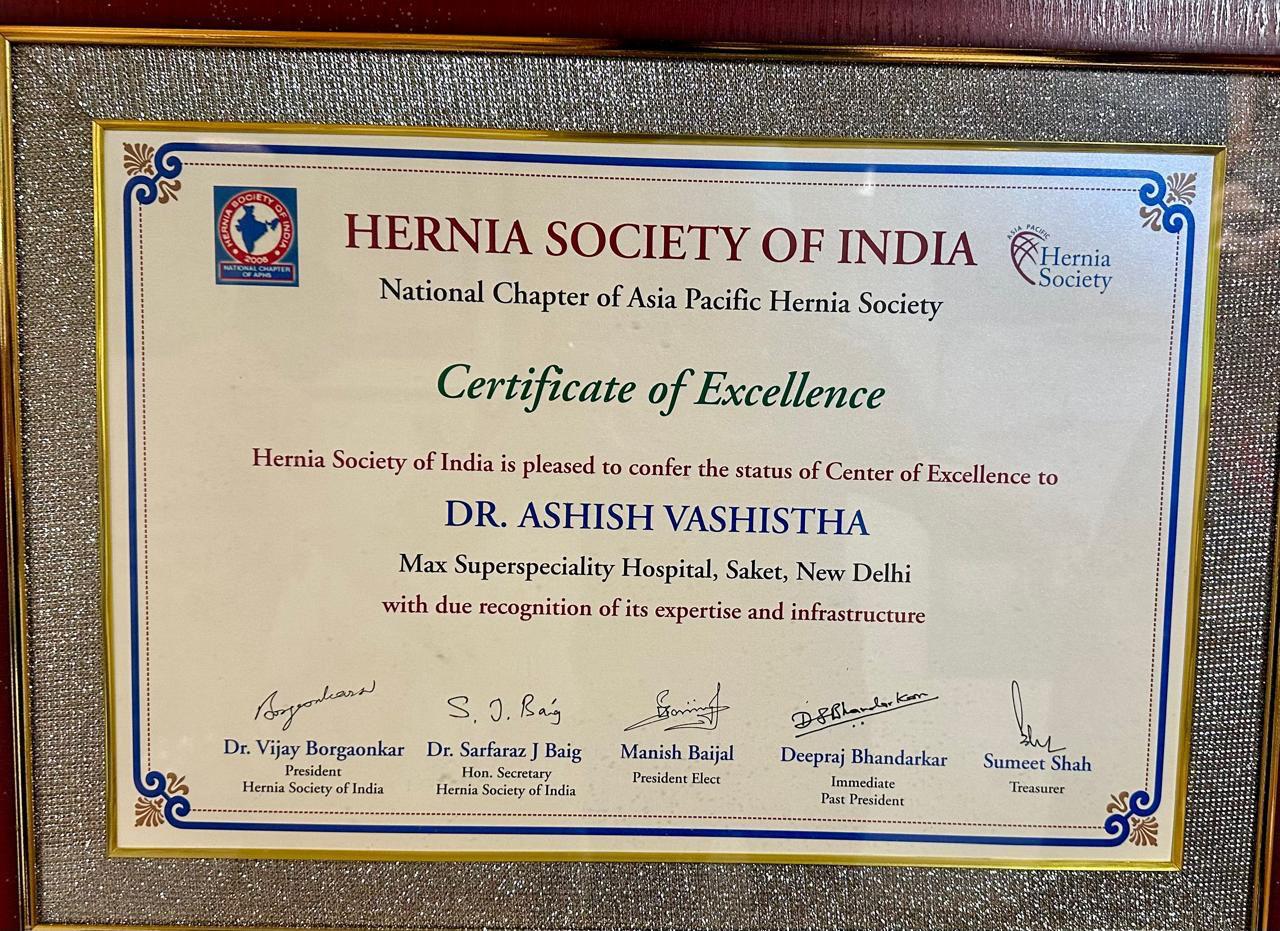
Dr. Ashish Vashistha is MBBS, MS (General Surgery), and holds fellowships including FNBE (Minimal Access Surgery), FIAGES, and FALS in Robotics, with close to three decades of surgical experience. He is Principal Director and Head of the Department of General Surgery & Robotics at Max Super Speciality Hospital, Saket, New Delhi, where he performs robotic hernia repair, including recurrent, bilateral, and complex cases, alongside standard laparoscopic and open techniques.
Book a Consultation with Dr. Vashistha
Why Choose Dr. Ashish Vashistha?
- Dr. Ashish Vashistha is a trailblazer in Minimal Access and Bariatric Surgery, with over 28 years of experience.
- Principal Director & HOD, General Surgery & Robotics, Max Super Speciality Hospital, Saket
- Senior Bariatric, Metabolic, Advanced Laparoscopic & Robotic Surgeon with 28+ years of experience
- Renowned for excellence in Gallbladder, Hernia, Bariatric, and advanced Robotic surgeries
- Trusted by thousands of patients for safe, minimally invasive, and fast-recovery surgical outcomes
- Published multiple research papers in Laparoscopic, Bariatric & Robotic Surgery
Robotic Hernia Surgery in South Delhi
Dr. Vashistha's practice is based at Max Super Speciality Hospital, Saket, within the South Delhi district. Patients from Saket and nearby South Delhi areas such as Malviya Nagar, Hauz Khas, Panchsheel Park, Greater Kailash, and Vasant Kunj often prefer evaluation close to home, particularly for recurrent or complex hernia cases that may involve more detailed pre-surgical planning.
Recovery After Robotic Hernia Surgery
Recovery is broadly similar to laparoscopic repair: most patients go home the same day or after a short stay, with gentle walking encouraged early and heavy lifting avoided for several weeks.
Recovery for complex, recurrent, or bilateral repairs can take somewhat longer than a straightforward first-time hernia, since more tissue is often involved. Your surgeon will give you a timeline specific to your case. Contact your surgeon promptly if you notice fever, spreading redness, or significant swelling after surgery.
Robotic Hernia Surgery Cost in Delhi
Cost depends on factors including whether the case is a first-time, recurrent, or bilateral repair, the complexity of the hernia, mesh type, and hospital charges. Robotic surgery costs are generally higher than standard laparoscopic repair due to the technology involved, but the right comparison is based on your specific case, not a general figure. An accurate estimate is only possible after a clinical evaluation.
Get a Cost Estimate After ConsultationFrequently Asked Questions
Not universally. Robotic surgery offers greater precision and range of motion, which is particularly valuable for recurrent, bilateral, or complex hernias. For straightforward, first-time hernias, laparoscopic repair often achieves an equally strong outcome at a lower cost.
It's generally considered for recurrent hernias, hernias on both sides (bilateral), larger or complex defects, and hernias in anatomically difficult locations, where the added precision genuinely changes the surgical approach.
Generally, yes, due to the technology and equipment involved. Whether the added cost is worthwhile depends on your specific case, which is best discussed during consultation.
Most patients return to light activity within a week to ten days, with full recovery, including return to heavier activity, typically taking a few weeks. Complex or recurrent repairs may take somewhat longer.
Most hernia types, including inguinal, umbilical, ventral, and hiatal hernias, can be treated robotically in appropriate cases. Whether it's the right approach for your specific hernia depends on its size, location, and complexity.
A recurrent hernia has scar tissue and altered anatomy from the previous repair, which generally makes the surgery more technically demanding. This is one of the situations where robotic precision is particularly useful.
Bilateral hernias (present on both sides) can generally be repaired in a single surgical session using robotic or laparoscopic technique, addressing both sides through the same set of incisions.
Precise mesh placement, which robotic technique supports particularly well in complex cases, is a meaningful factor in reducing recurrence, but no technique eliminates recurrence risk entirely. Overall surgical technique and post-operative care both matter.
Yes. Dr. Vashistha's practice is based at Max Super Speciality Hospital in Saket, within the South Delhi district.
If you have a recurrent hernia, a hernia on both sides, or a hernia that a previous surgeon has described as complex, it's worth seeking a surgeon with specific experience in robotic and complex hernia repair rather than a general first-time repair.
Not every hernia needs a robotic approach, but the ones that genuinely benefit from it, recurrent, bilateral, and complex cases, benefit a great deal. A proper evaluation tells you which category yours falls into.
Book a Consultation at Max Super Speciality Hospital, Saket