
Minimally Invasive Surgery Guide
Robotic and Laparoscopic Surgery in Delhi: A Guide to Gallbladder, Hernia and Bariatric Surgery
A comprehensive clinical guide comparing laparoscopic and robotic-assisted techniques across common general surgical procedures in Delhi.
Quick Summary
Laparoscopic vs. Robotic Surgery at a Glance
Robotic and laparoscopic surgery are both minimally invasive approaches used for gallbladder removal, hernia repair, and weight-loss (bariatric) surgery in Delhi. Laparoscopic surgery uses a camera and hand-held instruments through small incisions; robotic-assisted surgery adds a surgeon-controlled robotic system with high-definition 3D vision and wristed instruments. The right choice depends on your specific condition, surgical complexity, and your surgeon’s assessment — not on technology alone.
What This Guide Covers
If you or a family member has been advised to consider gallbladder, hernia, or bariatric surgery in Delhi, you have probably come across two terms repeatedly: laparoscopic and robotic. This guide explains what each approach actually means, how they compare across three common surgical conditions, and what to evaluate when choosing a surgeon — backed by verified surgical expertise at Aspire Life Robotics.
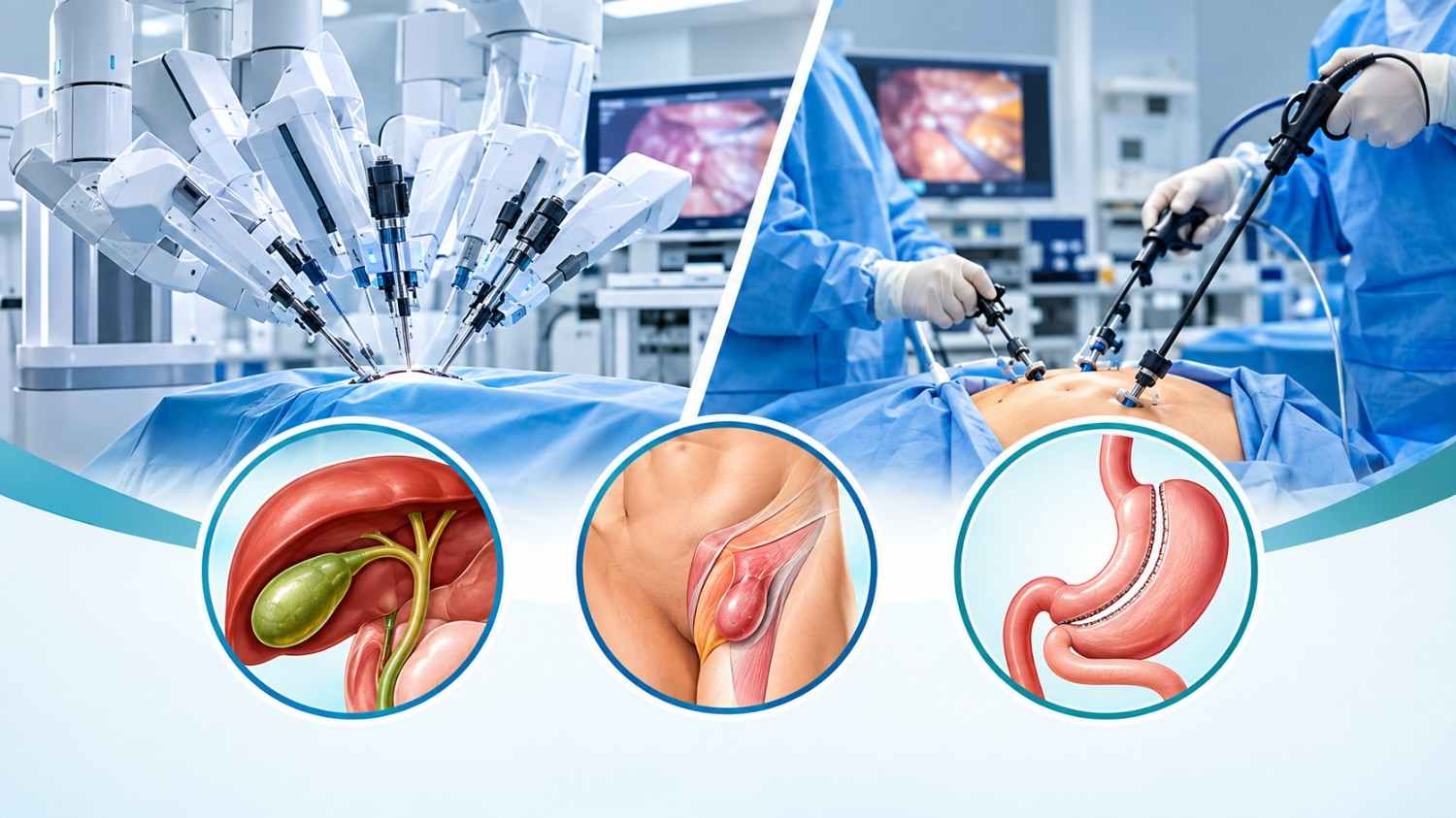
Technology & Technique
Understanding Minimally Invasive Surgery: Laparoscopic vs. Robotic
Both approaches fall under "minimally invasive surgery" — an alternative to traditional open surgery that utilizes tiny keyhole incisions rather than one large cut. Neither approach is a brand; both are surgical tools selected based on patient anatomy and clinical need.
What is Laparoscopic Surgery?
Laparoscopic surgery is a minimally invasive technique in which a surgeon operates through a few small incisions using long, hand-held instruments and a camera (laparoscope) that projects a magnified 2D image onto a high-definition monitor in the operating room.
What is Robotic-Assisted Surgery?
Robotic-assisted surgery is an advanced minimally invasive platform where the surgeon sits at an ergonomic console and directs robotic arms equipped with wristed instruments, guided by a magnified 3D view. The system does not operate autonomously — every movement is replicated by the surgeon in real time.
Head-to-Head Comparison: Laparoscopic vs. Robotic-Assisted Surgery
Key operational differences and suitability criteria between both surgical approaches.
| Factor | Laparoscopic Surgery | Robotic-Assisted Surgery |
|---|---|---|
| Visualization | 2D, magnified high-definition camera view | 3D, immersive high-definition magnified depth view |
| Instrument Control | Surgeon holds and manipulates rigid instruments manually | Surgeon controls articulated wristed robotic instruments via a console |
| Range of Motion | Limited by straight, rigid shaft instruments | EndoWrist instruments allow 360-degree articulation in tight spaces |
| Typical Incisions | Small keyhole incisions (typically 3–4 ports) | Small keyhole incisions, tailored to port geometry |
| Best Suited For | Wide range of routine and standard gallbladder, hernia, and bariatric cases | Complex, recurrent, or anatomically challenging cases requiring high precision |
| Availability | Widely available across general hospitals in Delhi NCR | Available at advanced tertiary hospitals with robotic surgical systems |
| Decision Factor | Selected based on surgeon experience, clinical history, and case complexity | Selected on medical indications and case demands — never marketing alone |
Clinical Focus Areas
The Three Core Specialties: Gallbladder, Hernia & Bariatrics
How laparoscopic and robotic methods are selectively applied across the three most common general surgery interventions.
1. Gallbladder Surgery
Cholecystectomy involves removing the gallbladder to treat symptomatic gallstones (cholelithiasis) or severe gallbladder inflammation (cholecystitis).
Gallstones affect an estimated 10–15% of adults globally and are statistically more common in women.
Surgical Approaches:- Laparoscopic Cholecystectomy: The worldwide gold standard for uncomplicated stones and polyps.
- Robotic Cholecystectomy: Indicated for severe acute inflammation, dense scar adhesions, or altered biliary duct anatomy.
2. Hernia Repair
Occurs when internal tissue pushes through a wall defect in the abdomen. The three common forms in adult patients are:
- Inguinal Hernia: Occurs in the groin (lifetime risk ~27% in men).
- Umbilical Hernia: Near the navel, linked with obesity or strain.
- Hiatal Hernia: Stomach pushes through the diaphragm into the chest.
Minimally invasive mesh repair restores abdominal strength. Robotic platforms excel in complex reconstructive cases and recurrent hernias.
3. Bariatric Surgery
Considered for eligible individuals with severe obesity after comprehensive metabolic evaluation. Common procedures include Sleeve Gastrectomy and Gastric Bypass.
According to NFHS-5 data, over 23–24% of adults in India are overweight or obese, with risks compounding at lower BMI cutoffs in South Asians.
Robotic platforms offer microsurgical precision for delicate tissue dissection, stapling, and suturing in high-BMI patients.
Clinical Leadership
Meet Dr. Ashish Vashistha: Principal Director & Head of Surgery
Aspire Life Robotics is led by Dr. Ashish Vashistha, who serves as Principal Director & Head of the Department of General Surgery & Robotics at Max Super Speciality Hospital, Saket, South Delhi.
With 28+ years of advanced surgical experience, Dr. Vashistha is widely regarded as a benchmark minimal access surgeon across Delhi NCR. He was awarded "Centre of Excellence" recognition for hernia surgery by the Hernia Society of India and has spearheaded prestigious national surgical conferences, including ROBOLAPCON and FALS Hernia.
His dual expertise across both laparoscopic and robotic modalities ensures that technology is chosen solely for clinical efficacy, providing individualized care tailored to the patient's exact anatomy and medical background.
28+ Years of Surgical Mastery:
Extensive track record spanning laparoscopic, bariatric, metabolic, and robotic abdominal surgery.
Tertiary Hospital Infrastructure:
Practicing at Max Super Speciality Hospital, Saket, with round-the-clock ICU, advanced anesthesia, and blood bank support.
Honors & Recognitions:
Recognized as a Centre of Excellence by the Hernia Society of India; National Convener for advanced laparoscopic & robotic training.
Unbiased Technique Selection:
Equally proficient in both standard laparoscopy and robotic consoles, matching the procedure to the patient rather than forcing one tool.
How to Choose the Best Surgeon in Delhi: 7 Key Checkpoints
Selecting a surgeon should always be based on qualifications, condition-specific case volume, and critical care backup — not marketing claims alone.
Board Certification
Verified formal training and accredited fellowship credentials in advanced minimal access and robotic surgery.
Condition Volume
High procedure-specific volume in your exact condition (gallbladder, specific hernia type, or bariatrics).
ICU & Critical Care
Tertiary hospital facility with dedicated surgical ICUs, 24/7 anesthesia teams, and advanced emergency backup.
Transparent Care
Clear pre-op communication detailing cost breakdowns, conversion protocols, and clear post-op plans.
Consultation Checklist
Questions to Ask Before Your Surgery
An informed patient achieves better outcomes. Prepare these questions for your consultation:
- 1. Exact diagnosis: What is my exact diagnosis, and what imaging/lab test confirmed it?
- 2. Technique choice: Is laparoscopic or robotic surgery recommended for my specific anatomy, and why?
- 3. Experience: How many procedures of this exact type have you performed?
- 4. Realistic risks: What are the specific complication risks given my medical history?
- 5. Conversion protocol: What happens if the procedure needs to be converted to open surgery?
- 6. Cost transparency: What is included in the package, and what unexpected factors could alter the cost?
- 7. Emergency & follow-up: Who do I contact directly if complications arise after discharge?
Patient Guidance
Preparing for Your Consultation & Second Opinions
How to Prepare:
- Carry all previous ultrasound, CT scans, blood work, and surgical records.
- Write down all ongoing medications (especially blood thinners or diabetes drugs).
- Document a chronological timeline of your symptoms and meal-related triggers.
When to Seek a Second Opinion:
Seeking a second opinion is prudent whenever open surgery is advised without clear rationale, before irreversible bariatric surgery, or when dealing with complex recurrent hernias. A skilled surgeon will always encourage second opinions.
Transparent Cost Note: Surgical costs in Delhi depend on technique, hospital room category, implant mesh/cartridges, and co-morbidities. Accurate quotes require individual clinical assessment.
Post-Operative Expectations
Recovery After Minimally Invasive Surgery
Both laparoscopic and robotic procedures dramatically minimize hospital stay, pain, and downtime compared with open surgery.
Day 1 - 2
Discharge usually occurs within 24 to 48 hours. Mild port-site tenderness is managed with oral analgesics. Early ambulation is encouraged immediately.
Week 1
Light routine indoor movement. Strenuous core exercises, weightlifting, and abdominal strain must be avoided while tissue planes seal.
Weeks 2 - 3
Most patients comfortably resume desk jobs, social routines, and driving. Surgical incision sites are well-healed.
Week 4 & Beyond
Full clearance for athletic activities, heavy work, and travel. Digestive adaptation stabilizes for cholecystectomy and bariatric patients.
Frequently Asked Questions
No. Both are effective, well-established minimally invasive approaches. Robotic surgery adds 3D visualization and wristed instrument control, which can help in complex or recurrent cases, but the best approach depends on your specific condition and your surgeon's assessment.
Laparoscopic surgery uses hand-held instruments and a 2D camera through small incisions. Robotic surgery uses the same small-incision principle with a surgeon-controlled robotic system offering 3D vision and wristed instruments.
This varies by procedure and by patient, but minimally invasive approaches generally allow a faster return to normal activity than open surgery (typically 1–2 weeks vs 4–6 weeks for open procedures). Your surgical team will provide an individualized timeline.
The most common types are inguinal (groin), umbilical (near the navel), and hiatal (stomach pushing into the chest), along with incisional hernias that occur at previous surgical scars.
Bariatric surgery is considered for eligible patients with obesity after individualized clinical evaluation, typically when non-surgical methods have not achieved health targets. It is a shared clinical decision based on your health profile.
Laparoscopic and robotic cholecystectomies are routine and safe, but removing an organ under general anesthesia is still a surgical procedure. Your surgeon will walk you through all patient-specific benefits and risks.
Yes. The liver continues to make bile, which flows directly into the small intestine. Most people adjust well within a few weeks, though temporary digestive sensitivity to high-fat foods can occur.
Surgical mesh is standard in adult laparoscopic and robotic repairs to reinforce weakened abdominal muscle and lower recurrence rates. The exact technique and mesh type depend on the size and location of the hernia.
Cost depends on the procedure, hospital choice, room category, patient medical complexity, and length of stay. An exact estimate requires a pre-operative clinical evaluation.
While not mandatory, it is a sound step for complex diagnoses, before irreversible procedures like bariatric surgery, or whenever open surgery is advised over minimally invasive options.
Ask why the robotic method is recommended for your specific anatomy, how many robotic procedures the surgeon has personally performed, conversion-to-open protocols, and package inclusions.
Dr. Ashish Vashistha practices at Max Super Speciality Hospital, Saket, New Delhi, where he serves as Principal Director & HOD, Department of General Surgery & Robotics.
Schedule an in-depth consultation with Dr. Ashish Vashistha at Max Super Speciality Hospital, Saket to evaluate whether laparoscopic or robotic surgery is best suited for your medical needs.
Book a Consultation at Max Super Speciality Hospital, Saket