Proctology & Colorectal Care
Piles vs Fissure vs Fistula: What Is the Real Difference?
Pain, bleeding and discomfort around the anus can come from several different conditions, and piles, fissures and fistulas are often confused with one another because the symptoms overlap. All three affect the same general area, but they are different problems with different causes, and they are not treated the same way.
This guide breaks down what separates piles (hemorrhoids), anal fissures and fistula-in-ano, how each one typically presents, and what to expect from evaluation and treatment. It is written for general understanding and does not replace an in-person examination, since a proper diagnosis for any of these conditions requires a doctor to physically examine the area.
Why These Three Conditions Get Confused
Piles, fissures and fistulas share a cluster of overlapping symptoms: pain during bowel movements, bleeding, itching and a general sense that something is wrong in the anal area. Patients often describe all three simply as “piles” because that is the most commonly heard term, even when the actual diagnosis is a fissure or a fistula.
The distinction matters because the treatment approach is different for each condition. Medication that helps a fissure heal will not close a fistula tract. Diet changes that manage mild piles will not resolve a chronic fissure. Getting the diagnosis right is the first step toward the right treatment.
Clinical Overview
Understanding Piles, Fissures, and Fistulas
While all three conditions affect the same region, each has distinct physiological characteristics, risk factors, and presentation patterns.
What Are Piles (Hemorrhoids)?
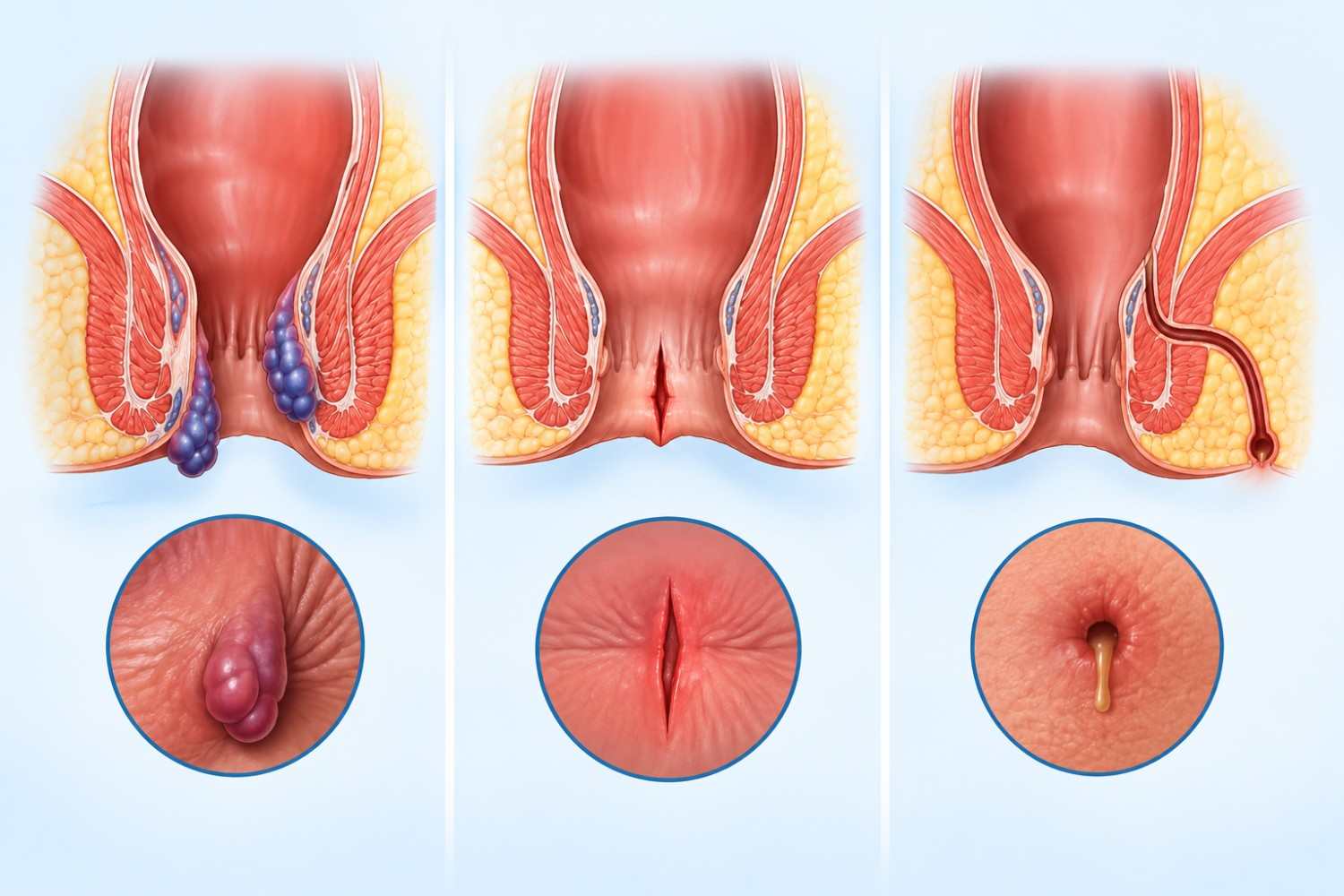
Piles, medically known as hemorrhoids, are enlarged veins inside or around the anus and lower rectum. They develop when pressure builds up in the lower bowel, most often from straining during bowel movements, chronic constipation, prolonged sitting, or pregnancy, causing the veins to stretch and swell.
Piles can be internal, forming inside the rectum, or external, forming under the skin around the anus. Internal piles are frequently painless in the early stages and may only be noticed as bleeding, while external piles are more likely to cause pain, swelling or itching.
Common Signs of Piles:- Bright red blood on tissue or in the stool during or after a bowel movement
- Persistent itching or irritation around the anus
- A soft lump or swelling that appears during bowel movements and may need to be pushed back in
- A sensation of fullness or incomplete emptying after passing stool
What Is an Anal Fissure?
An anal fissure is a small tear or split in the lining of the anal canal. It usually happens when a hard or unusually large stool stretches the tissue beyond what it can comfortably handle, though repeated diarrhea, childbirth or other trauma to the area can also cause one.
Because the anal lining is thin and richly supplied with nerve endings, even a small fissure can cause disproportionately sharp pain. This pain often triggers spasm in the surrounding sphincter muscle, which in turn reduces blood flow to the area and can make the fissure slower to heal, sometimes turning a short-term problem into a chronic one.
Common Signs of an Anal Fissure:- A sharp, often severe pain during and immediately after passing stool
- A visible crack or tear in the skin around the anal opening
- Bright red blood, usually a smaller streak on the stool or tissue rather than active bleeding
- Muscle spasm or tightness that adds to the discomfort between bowel movements
What Is a Fistula-in-Ano?
A fistula-in-ano is an abnormal tunnel that forms between the anal canal and the skin near the anus. It almost always develops after an anal abscess, a collection of pus caused by infection, has drained either on its own or through treatment. Once the abscess drains, a tract can remain behind, connecting the inside of the anal canal to an opening on the skin.
Unlike a fissure, which is a surface-level tear, a fistula is a structural passage that runs through tissue. This is why a fistula essentially never heals on its own and why ongoing or recurring drainage and infection are common until it is treated.
Common Signs of a Fistula-in-Ano:- Persistent or throbbing pain that worsens with sitting, walking, coughing, or during bowel movements
- A small, tender lump or swelling near the anus
- Recurrent abscesses or repeated episodes of swelling and pus collection in the same area
- Ongoing discharge, which may be bloody, pus-like, or have an odor
Specialist Profile
Consult Dr. Ashish Vashistha in Delhi
Dr. Ashish Vashistha is a laparoscopic and robotic surgeon with 28+ years of experience, currently serving as Principal Director and Head of the Department of General Surgery & Robotics at Max Super Speciality Hospital, Saket, New Delhi.
His practice offers laser and minimally invasive treatment for piles, fissures and fistula-in-ano, alongside gallbladder, hernia and bariatric surgery, allowing patients to get an accurate diagnosis and the appropriate treatment plan under one roof.
If you are dealing with anal pain, bleeding, or swelling and are not sure which of these three conditions applies to you, a consultation is the most reliable way to find out and to discuss a treatment plan suited to your specific case.
Experience:
28+ years across general, laparoscopic, laser and robotic surgical care.
Leadership & Affiliation:
Principal Director & HOD, General Surgery & Robotics at Max Super Speciality Hospital, Saket, South Delhi.
Treatment Spectrum:
Minimally invasive stapler surgery, laser piles surgery, laser fissure repair, and advanced fistula procedures.
Patient Approach:
Personalized differential diagnosis to avoid misdiagnosing fissures or fistulas as simple piles.
Why Consult Dr. Ashish Vashistha for Anorectal Care
Distinguishing between piles, fissures, and fistulas requires careful physical evaluation, advanced visualization equipment, and individualized surgical planning.
Accurate Diagnosis
Comprehensive clinical examination and proctoscopy to pinpoint the exact condition before prescribing treatment.
Minimally Invasive Care
Access to advanced laser and stapler techniques aimed at shorter recovery times, reduced pain, and lower recurrence.
Tertiary Infrastructure
Operates out of Max Super Speciality Hospital, Saket, providing state-of-the-art diagnostic imaging and safety.
Tailored Plan
Conservative medical options for early-stage issues and targeted surgical repair for chronic or non-healing cases.
Clinical Evaluation
How Doctors Tell Them Apart
A colorectal or general surgeon typically starts with a clinical history and a physical examination of the anal area. Many fissures and external piles can be identified this way alone, since the tear or swelling is often visible on inspection.
For internal piles, a proctoscope or anoscope, a short lit instrument, may be used to view inside the anal canal. For a suspected fistula, the surgeon looks for the external opening and may gently probe the tract to understand its path; complex or recurrent fistulas sometimes need imaging, such as an MRI fistulogram, to map the tract fully before surgery is planned, since fistulas can branch or run close to the sphincter muscles that control continence.
Important Distinction
When to Rule Out Other Conditions
Persistent bleeding, unexplained weight loss, or a change in bowel habits should always be evaluated properly, since these can occasionally point to conditions other than piles, fissures or fistulas and are not something to self-diagnose.
Self-treating based on an unconfirmed guess can delay proper care. A specialist evaluation ensures that benign anorectal issues are treated effectively while ruling out more serious underlying colorectal conditions.
Piles vs Fissure vs Fistula: Side-by-Side Comparison
The table below summarizes the practical differences. It is a general guide, not a substitute for an examination, since symptoms can overlap or present atypically.
| Factor | Piles (Hemorrhoids) | Anal Fissure | Fistula-in-Ano |
|---|---|---|---|
| What it is | Swollen, enlarged veins inside or around the anus and lower rectum | A small tear or split in the lining of the anal canal | An abnormal tunnel between the anal canal and the skin near the anus |
| Usual cause | Increased pressure in the lower bowel from straining, chronic constipation, or prolonged sitting | Stretching or injury to the anal lining, often from passing a hard or large stool | Almost always follows an anal abscess that has drained, leaving a tract behind |
| Typical pain pattern | Often painless if internal; external piles can cause pain, itching, or a lump | Sharp, often severe pain during and after bowel movements | Constant or throbbing pain that worsens with sitting, walking, or coughing |
| Bleeding | Bright red blood on stool or tissue is common | Bright red blood, usually in smaller amounts, linked to the tear | Bleeding or discharge from an opening near the anus, sometimes with pus |
| Other signs | A soft lump or prolapse that may need to be pushed back in | Visible crack in the skin around the anus, muscle spasm | Swelling, recurrent abscesses, and a persistent discharge or odor |
| First-line approach | Diet and lifestyle changes for mild cases; laser or stapler surgery for moderate to severe piles | Conservative care first; laparoscopic or laser fissure surgery for chronic or non-healing fissures | Surgery is generally required, since a fistula rarely closes on its own |
Clinical Indicators
When Should You See a Specialist?
It is worth booking a consultation with a colorectal or general surgeon if you notice any of the following, rather than waiting for symptoms to resolve on their own:
- Bleeding during or after bowel movements, even if it seems minor
- Pain that is severe, persistent, or getting worse over days or weeks
- A lump, swelling, or discharge near the anus that does not go away
- Symptoms that keep recurring despite dietary and lifestyle changes
- Fever, spreading redness, or increasing swelling, which can indicate an active infection
Warning: An accurate diagnosis is what determines whether the right next step is a change in diet, a course of medication, or surgery. Self-treating based on a guess between piles, fissure and fistula can delay the correct treatment, particularly for a fistula, which will not resolve without intervention.
Diagnostic Importance
Why In-Person Examination is Vital
Because piles, fissures, and fistulas originate in the same area and produce similar discomfort, patients often mistakenly purchase over-the-counter piles ointments for an anal fissure or a fistula tract.
- Ointments won't heal a fistula: A fistula is an infected structural tunnel that requires definitive surgical clearance.
- Fiber won't fix chronic spasm: While high-fiber diets soften stools, chronic fissures with severe sphincter spasm frequently need laser or surgical release.
- Ruling out other bowel issues: Recurring rectal bleeding should always be evaluated under proper magnification to ensure accurate diagnosis.
Dr. Ashish Vashistha provides complete clinical evaluations at Max Super Speciality Hospital, Saket, ensuring the root cause of your symptoms is accurately addressed.
Procedural Overview
Treatment Approaches Compared
Treatment is matched to the specific condition rather than the general area of discomfort.
Piles Treatment
Mild piles are often managed first with dietary fiber, adequate fluids, and changes to toilet habits that reduce straining. When piles are moderate to severe, persistent, or prolapsing, surgical options include minimally invasive stapler surgery for hemorrhoids and laser piles surgery, both aimed at shorter recovery and less discomfort than traditional open surgery.
Fissure Treatment
Fresh, acute fissures often respond to conservative measures such as stool softeners, increased fiber, and topical treatments that help relax the sphincter muscle and improve blood flow to the area. When a fissure becomes chronic and does not heal with conservative care, laparoscopic or laser fissure surgery can repair the tear and address the underlying muscle spasm that was keeping it from healing.
Fistula Treatment
Because a fistula tract does not close on its own, surgery is generally the definitive treatment. The approach depends on how complex the tract is; straightforward fistulas may be treated with laser or minimally invasive techniques, while complex, recurrent, or horseshoe-shaped fistulas, or those associated with an abscess, may require a more involved conventional or staged surgical approach to fully clear the tract while protecting sphincter function.
Frequently Asked Questions
Yes. It is possible to have more than one of these conditions at once, for example a fissure alongside piles, since straining and constipation are risk factors common to both. This is one more reason a physical examination is important rather than assuming a single cause.
Not necessarily. Fissures also cause bleeding, and rarely, bleeding can be linked to other conditions of the lower bowel. Any rectal bleeding, especially if it is recurring, should be evaluated by a doctor rather than assumed to be piles.
A fissure and a fistula develop through different mechanisms; a fissure is a surface tear, while a fistula usually follows an abscess. A fissure does not typically progress into a fistula, though both can occur independently in the same patient.
Piles, fissures and fistulas are not cancerous and are not established causes of cancer. That said, symptoms like bleeding, a persistent lump, or a non-healing wound should always be checked by a doctor to rule out other conditions, particularly if symptoms are new, persistent, or occur after age 45 to 50.
Recovery time depends on the condition and the treatment chosen. Minimally invasive options such as laser or stapler surgery for piles, and laparoscopic or laser fissure and fistula repair, generally allow for a faster return to normal activity than traditional open surgery, though the exact timeline varies by case and should be discussed with the treating surgeon.
If you are dealing with anal pain, bleeding, or swelling and are not sure which of these three conditions applies to you, getting an expert evaluation at Max Super Speciality Hospital, Saket can help determine an accurate diagnosis and treatment plan.
Book a Consultation at Max Super Speciality Hospital, Saket